



Plitvice Lakes National Park in Winter, Croatia. Teaser
Plitvice Lakes National Park is located in the central part of Croatia and covers an expanse of almost 30,000 hectares. In 1949 this area became the national park, and 30 years later it was added to the UNESCO World Heritage Register. The park is forested with beech, spruce, and fir; and is the home for hundreds of species of plants, animals and birds. But it is mainly known for its water areas: rivers flowing through the limestone carved the landscape and formed natural dams, cascades of lakes, waterfalls and caves.

There are 16 large karst lakes and a lot of smaller ones; the total area of their coverage is 217 hectares. These lakes are fed by five rivers: the Korana, the Crna, the Bijela and the Rječica. The lakes are arranged in cascades, the highest one is the Prošćansko at 636 meters above sea level. The lowest one is lake Novakovića-Brod at an altitude of 503 meters.

There are more than one hundred waterfalls in the park and new ones appear annually. This process is the result of the way the travertine barriers are formed: these barriers are made not from rocks, but from the deposition of plants. The trees and branches fallen in the water get calcified and create solid depositions blocking rivers. The water gradually erodes the dams giving the way to new waterfalls. Sastavci is considered to be the most beautiful one with a height of 72 meters.

One more interesting feature of the national park is its caves; some of them being located right under the waterfalls. Sometimes they bear rather strange names: Šupljara ("cave without floor and ceiling", "hole-cave"), Crna pećina ("black cave"), Mračna ("sombre cave"). The bats living in these caves among stalactites and stalagmites can vouch for the accuracy of the names!

The park had been inaccessible to visitors until 1958, but then the tourist infrastructure began developing. Pavements and footpaths were created, routes for diesel and eco-friendly electrical trains, ferries and boats were developed. The park is a popular destination during the warm season. It's a pleasure to watch multi-coloured landscapes, emerald-green water and trees featuring all shades of green.

In winter, nature falls into slumber, but it still reveals all kinds of its beauty. The bright colours are replaced by sparkling whiteness, the waterfalls are frozen and the trees bend under the weight of snow; these landscapes seem to have leapt from the pages of a fairytale. The AirPano team wants to show you the Plitvice Lakes just exactly as they are: gorgeous and elegant.
Video and photos by Sergey Shandin and Stas Sedov. Video stitching by Ivan Roslyakov
26 December 2017
Read more
 Pevalek falls
 Plitvice Lakes National Park in winter
 Great Waterfall (Veliki Prštavac)
 Frozen waterfall
 Fog near the falls
 Gradinsko Lake
 In the Plitvice Lakes National Park
 Forest waterfall
 Grey heron
 Old mill above the waterfall
 Bird’s eye view of the national park
 Pevalek falls




Virtual Travels in 360°
 French Polynesia. Part I
 Cinque Terre, Italy
 Manarola, Cinque Terre, Italy
 Vernazza, Cinque Terre, Italy
 Trip to Raja Ampat archipelago, Indonesia
 Beaches of Rio de Janeiro, Brazil
 Mont Blanc, Italy-France. Part II
 Kronotsky Nature Reserve, Kamchatka, Russia
 Kronotskoye Lake. The biggest lake of Kamchatka, Russia
 Scenic flight over Los Angeles, California, USA
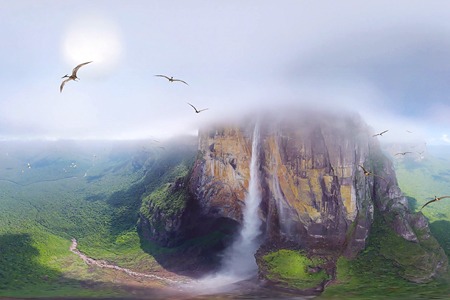 Angel Falls millions of years ago
Show more
